
PayTo Alias Resolution
PayTo Alias Resolution
This article will guide you on how to utilise Zepto's PayTo Alias Resolution Service.
PayTo Alias Resolution Overview
The PayTo Alias Resolution endpoint is a compulsory service that must be utilised before establishing a PayTo agreement when PayID is used as an account_identifier type such as alias_phone, alias_email, alias_abn, and alias_organisation_identifier.
The service offers two primary benefits:
- Enhanced confidence: Provide real-time PayID validation feedback during the checkout process, increasing confidence in the transaction's accuracy.
- Fraud prevention: Mitigate illegitimate activity by leveraging Zepto's integrated fraud prevention measures.
Implementation Guidelines
- A PayTo agreement creation request should only be initiated once the PayID has successfully been validated (i.e. 200 response from POST /payto/alias_resolution)
- A PayTo agreement creation request should not be initiated should the alias resolution request return any other response (i.e. 4XX or 5XX)
- The "
display_name" associated with a registered PayID is provided in the 200 response and can be used as validation against your customer record prior to creating a PayTo agreement
{
  "data": {
    "display_name": "James Citizen"
  }
}
CX Guidelines
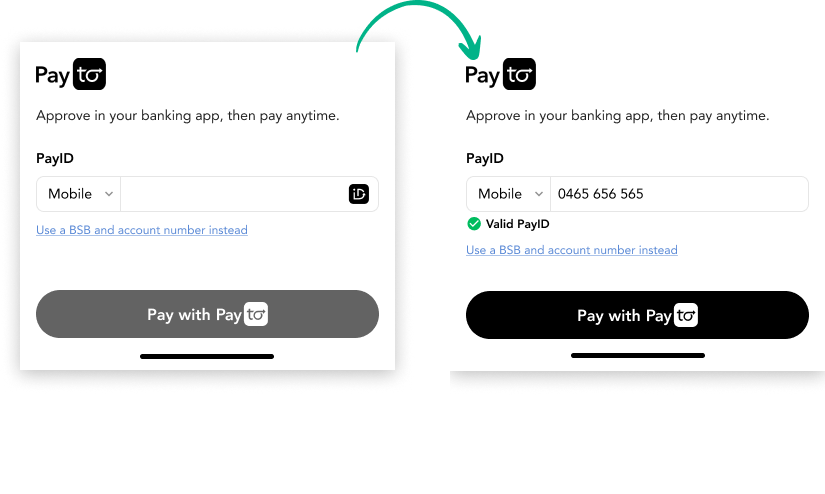
- The merchant application should provide real-time visual feedback to the customer to confirm the validity of the PayID
- Only once the PayID has been validated can the customer finalise the checkout process
Initiating a Lookup
To make use of this function please enable the pay_to_aliases scope within your Zepto API settings.
Endpoint
Parameters
Parameters | Description |
| Select from 4 alias types:
|
| The value of the PayID (e.g. |
| A unique identifier of the end customer. |
| The IP address of the end customer. |
Requester Information
The requester object (i.e. id and remote_ip) is used to collect the details of the end-user requesting this resolution. This is done as an integral component of Zepto's strategy for preventing fraudulent activities and safeguarding against enumeration attacks, ultimately ensuring the security of the end customer's data. Zepto will be able to provide further details around fraud prevention and usage limits during technical discussions.
{
  "type": "alias_phone",
  "value": "+61-411222333",
  "requester": {
    "id": "user_G7MQWwkQZIP8vbfH",
    "remote_ip": "192.0.2.146"
  }
}
{
"data": {
"display_name": "Jane Smith"
}
}{
"errors": [
{
"title": "Validation Failed",
"detail": "The value for `alias_owner` is not allowed"
}
]
}{
"errors": [
{
"title": "Alias not found",
"detail": "The given alias was not able to be resolved",
"code": "ZPADD01"
}
]
}Notable Fields
Success
Field | Description |
| Display name associated with the alias. |
Failed Lookup
When an alias resolution request is submitted and fails (eg. alias does not exist or the fraud prevention limits have been reached), Zepto will return a (422) response detailing any errors responsible for the invalid request.
Field | Description |
| Error title |
| Error description |
| Error code |
Updated 3 months ago